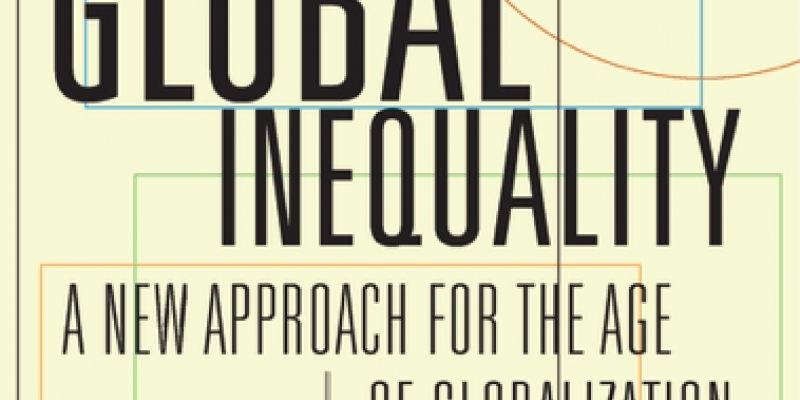
One of the world’s leading economists of inequality, Branko Milanovic presents a bold new account of the dynamics that drive inequality on a global scale. Drawing on vast data sets and cutting-edge research, he explains the benign and malign forces that make inequality rise and fall within and among...

To benchmark and monitor economic inequality across countries, the OECD relies on two dedicated statistical databases: the OECD Income Distribution Database (IDD), which offers data on levels and trends in income inequality and poverty, and the OECD Wealth Distribution Database (WDD), which collects...

Realtime Inequality - Who Benefits from Income and Wealth Growth in the United States?
Realtime Inequality provides the first timely statistics on how economic growth is distributed across groups. When new growth numbers come out each quarter, the economists from Berekely show how each income and...

We feel instinctively that societies with huge income gaps are somehow going wrong. Richard Wilkinson charts the hard data on economic inequality, and shows what gets worse when rich and poor are too far apart: real effects on health, lifespan, even such basic values as trust.

WID.world combines different data sources: national accounts, survey data, fiscal data, and wealth rankings. By doing so, it becomes possible to track more precisely the evolution of all income or wealth levels, from the bottom to the top. The key novelty of WID.world is to use such data in a system...

What are the grand dynamics that drive the accumulation and distribution of capital? Questions about the long-term evolution of inequality, the concentration of wealth, and the prospects for economic growth lie at the heart of political economy. But satisfactory answers have been hard to find for la...